An attacker handed an AI-driven penetration-testing framework a target and a goal. In August and September, the framework ran 25 operations against at least 19 organizations; it confirmed unauthorized access or data retrieval at 10 of them, according to Palo Alto Networks Unit 42’s investigation. Semiconductor suppliers, a defense-policy program and civil-society groups were among the targets. One semiconductor company’s production partner application ended up with unauthorized administrator accounts and a persistent API token.
At a U.S. teachers’ union, the framework logged access to more than one million member records, roughly 31,000 CRM contacts and staff password hashes. At an industry standards body, attackers obtained dozens of valid credentials and overwrote a live standards-ballot document through an unauthenticated cloud-storage write. Unit 42 attributes the campaign to the group it tracks as CL-STA-1238 and assesses a China-nexus intelligence-collection purpose with moderate confidence. The investigation is vendor research; Palo Alto Networks also evaluates and markets its own security products in the report.
Cairn selects each next action
The attackers used a customized fork of the open-source Cairn framework with Zhipu GLM 5.2 and DeepSeek V4 Flash/Pro models. An operator supplied an organization’s root domain and an objective. In one task against a semiconductor equipment supplier, the operator also supplied VPN gateway addresses, groups and shared group passwords. Operators could also add hints while agents worked.
Cairn’s AI worker first tries the goal, then breaks it into smaller tasks. In its Reason phase it reads accumulated findings and chooses an action; in Explore it performs that action and records the result. Its shared blackboard retains confirmed facts and queues new intents. The loop continues until the model judges the goal met or exhausted, or the operator stops it. Individual operations lasted from 20 minutes to more than 50 hours. The diagram shows where operator tasking enters and how a completed action becomes input to another decision.
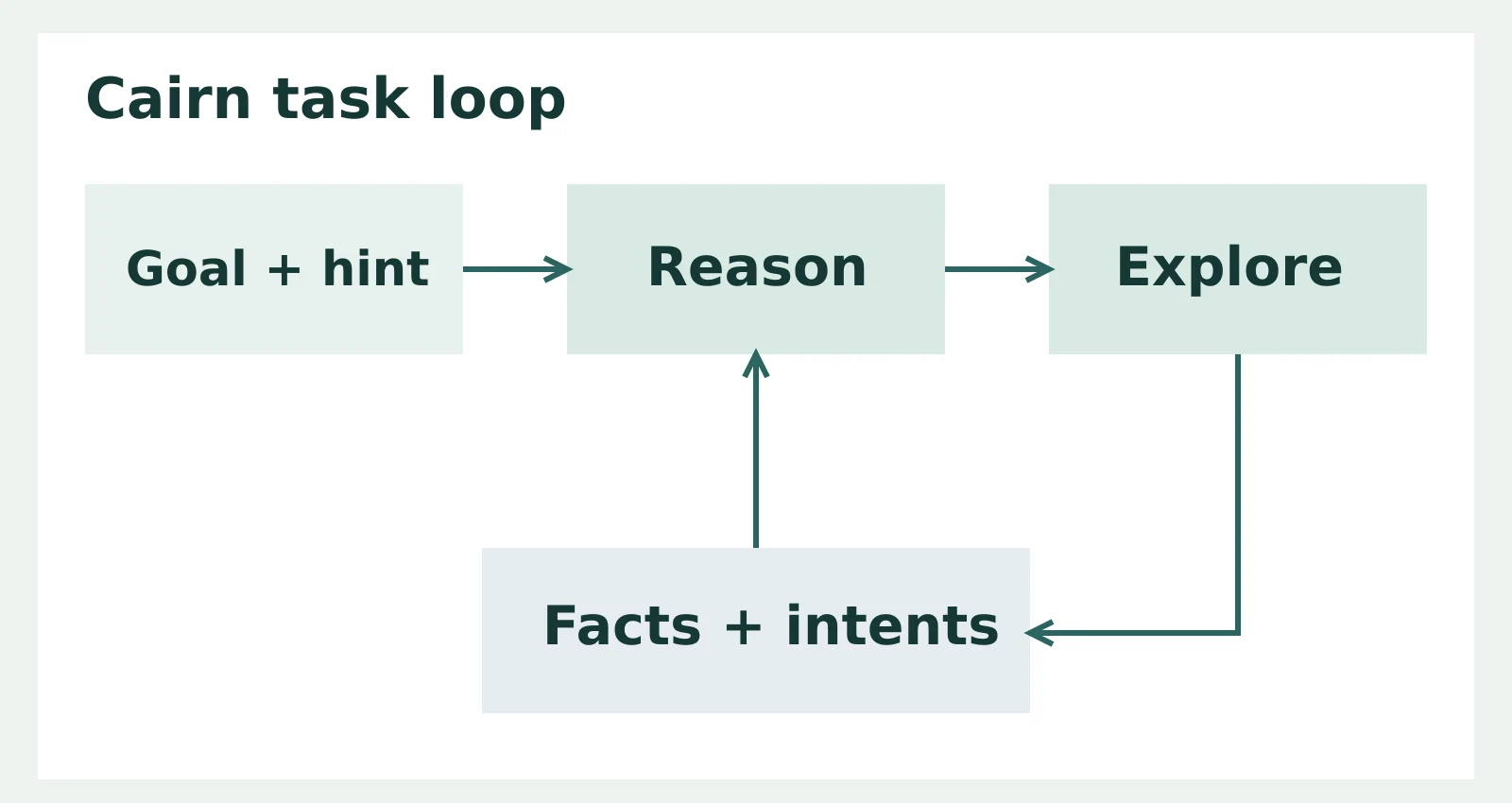
Figure details
Four labeled boxes read “Goal + hint,” “Reason,” “Explore,” and “Facts + intents.” Arrows lead from Goal + hint to Reason, Reason to Explore, Explore down to Facts + intents, and Facts + intents back up to Reason. The bottom box represents Cairn’s shared blackboard and the return arrow depicts another worker decision.
The fork loaded a campaign-specific skill pack named AIScan Runner Skills. The attackers also prepended an authorization claim to the worker prompt and generated an AUTHORIZATION.md file for each operation. Unit 42 says neither model refused that framing. These were attacker-supplied claims of authorization, not evidence that the targeted organizations approved the activity.
Ordinary weaknesses yielded lasting access
The framework found familiar entry routes: authentication bypasses, weak or default passwords, insecure direct object references, mass-assignment privilege escalation, exposed cloud APIs and older public CVEs. Unit 42 puts it plainly: “Autonomous AI raises the volume and coverage of exploitation, but not its complexity.” The orchestration let a likely single operator or small team run intrusion attempts against 19 organizations in two weeks.
At the semiconductor company’s partner-integration application, attackers brute-forced a production credential valid across multiple accounts, retrieved user and email lists, then created administrator accounts and a persistent API token. At the teachers’ union, an unauthenticated CMS account-creation bypass produced valid sessions. A defense-policy program’s identity backend exposed an open registration endpoint; the framework retrieved roughly 500 user records, including accounts with .mil and .gov domains. The .mil and .gov addresses came from the defense program’s user records; the reported access was to that program’s identity backend.
At the standards body, weak-password spraying yielded credentials and private directory data, while a separate unauthenticated storage write changed a live ballot file. Restoring one account or fixing only the login form would leave that storage-write route open.
Recognize the operator’s foothold
Unit 42 lists 154.44.31[.]4 as the Hong Kong Cairn hosting server and 82.29.129[.]54 as a U.S. staging and attack-egress server. Use those values as leads in ingress, WAF, VPN and application logs for the August–September activity window, then correlate with authentication failures, successful sessions, new administrator accounts, token creation, unusual bulk reads and storage writes. A match is a triage lead; the same access paths can be used without those two addresses.
Look first at systems resembling the reported entry points: partner-integration portals, internet-facing application servers, CMS account registration, identity-platform backend registration and cloud object writes. Compare new principals and API tokens with change records and account owners. For a record-read event, check the application’s export or access logs and the affected identity’s permissions before estimating data exposure. A forged administrator account or unexpected persistent token warrants revocation and an investigation of the sessions and objects it touched.
Remove the reported entry routes
Require strong authentication on partner and administrative interfaces, remove shared production credentials, and restrict registration endpoints to the intended enrollment flow. NIST SP 800-63B recommends controls against online password guessing, including rate limiting, and requires applications assessed at AAL2 to offer a phishing-resistant authentication option. Apply those controls to the interfaces where a password grants production access; rate limits alone cannot repair the unauthenticated CMS bypass.
Block unauthenticated writes to the affected cloud-storage objects and require server-side authorization for each user, object and administrative function. Patch the older public CVEs in reachable services and remove default credentials. For the reported compromise patterns, revoke unauthorized API tokens, remove unapproved administrator accounts, rotate credentials exposed by the intrusion and review the affected data and documents. Unit 42 publishes no product-specific fixed build for this campaign’s varied entry points; use each application’s own remediation record to track the change.
Test the actual flows after the changes: unauthenticated requests to the CMS registration bypass and storage write must fail, an unprivileged account must be denied administrative actions and cross-account data, and a revoked token must fail on the production API. Pair those results with application and identity logs showing who accessed the records before the fix.